Cutting Through Complexity as CEO

Authored by , Senior Editor, Criticaleye
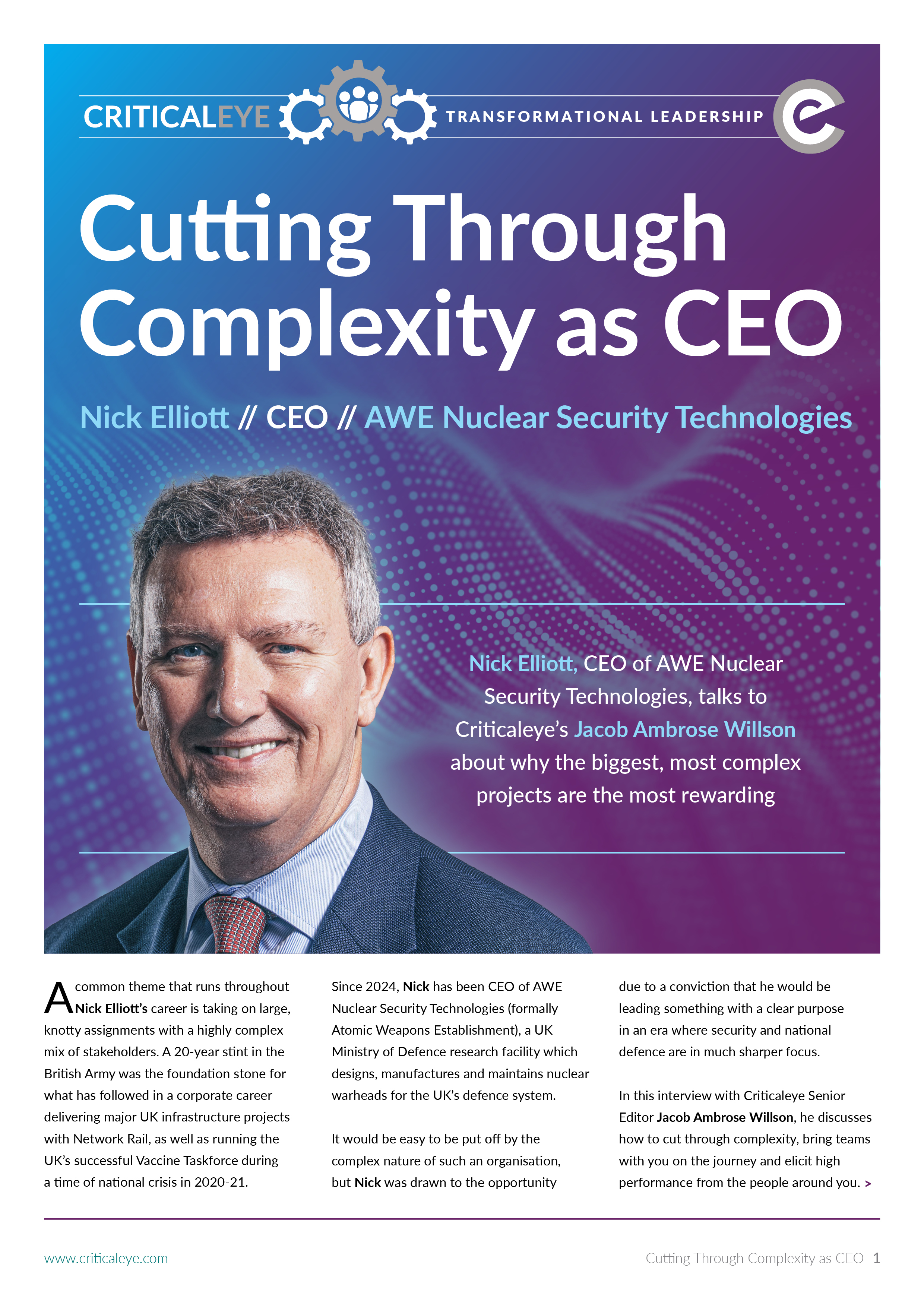
Nick Elliott, CEO of AWE Nuclear Security Technologies, talks to Criticaleye’s Jacob Ambrose Willson about why the biggest, most complex projects are the most rewarding.
A common theme that runs throughout Nick Elliott’s career is taking on large, knotty assignments with a highly complex mix of stakeholders. A 20-year stint in the British Army was the foundation stone for what has followed in a corporate career delivering major UK infrastructure projects with Network Rail, as well as running the UK’s successful Vaccine Taskforce during a time of national crisis in 2020-21.
Since 2024, Nick has been CEO of AWE Nuclear Security Technologies (formally Atomic Weapons Establishment), a UK Ministry of Defence research facility which designs, manufactures and maintains nuclear warheads for the UK’s defence system.
It would be easy to be put off by the complex nature of such an organisation, but Nick was drawn to the opportunity due to a conviction that he would be leading something with a clear purpose in an era where security and national defence are in much sharper focus.
In this interview with Criticaleye Senior Editor
Jacob Ambrose Willson, he discusses how to cut through complexity, bring teams with you on the journey and elicit high performance from the people around you.
JAW: Looking at your career, there seems to be a pattern of delivering on large-scale projects. What’s been the appeal for you operating in that kind of environment?
NE: I think it just comes down to the fact I like a challenge. But I also like to do things which I think have a sense of purpose. Things which are of real importance. Those things that generally add value to how we operate as a group of humans, as an organisation, as a country. If you want to do those sorts of things, they tend to be the most complex and challenging.
But the hardest things are the most rewarding, and once you've got that appetite for it, there's no going back, almost. Once you deal with big challenges, you've been put under pressure, you've had to think differently, you've had to apply yourself to solutions – it feels compelling. You want to do more of that. You want to feel that you're making a difference. I've been fortunate enough to have a lot of different jobs that have allowed me to do that, which has been fantastic.
JAW: As a leader, what’s your approach to cutting through complexity to ensure those around you have clarity in what they’re trying to achieve?
NE: One thing you've got to do is be really clear about the expectation of what success looks like – so giving real clarity to the organisation, the people in the organisation, your leadership team, the team around you. What does success look like? What is the compelling vision that describes what it is you're there to do and what you're there to achieve? And what will it look and feel like if you've done it? If you can describe that in a tangible way, people will buy into that. And then, all of a sudden, you've got that group mentality towards delivering that outcome.
JAW: How have you employed this methodology while in the CEO role at AWE?
NE: It's a really big, complicated organisation with a lot of challenges. But my mantra from day one was, ‘We're going to simplify and amplify. We're going to cut through our bureaucracy. We're going to make things as simple as possible and we're going to do more of it. We're going to amplify, we're going to do it faster and we're going to do it to a greater volume.’
if you don't have that focus you can get drowned in complexity, drowned in the day-to-day activity that's going on around you – the thousands of emails that are coming in, all of the targets you've got to deliver that day, that week, that month. It just overwhelms you. So you've got to take a step back, find some time to think and say, ‘Right, what do I do to cut through this?’ And if it's that difficult, take the Gordian Knot approach – get a big sword and chop through the whole thing.
JAW: What do you look for in a leadership team? How do you know when it’s high performing?
NE: The team is hugely important. First of all, I'm looking for people who buy into the vision that you've defined for the organisation, or the business, or the bit of the business you're in. You need people who do genuinely believe, so you need to test that and make sure that they're actually committed to it. I want people who are inquisitive, resilient, who take ownership, who also want to build their own teams. They are making sure they are building the team that supports them to deliver these outcomes as well. It's not just about them as individuals. I want people who listen as much as they talk.
JAW: How do you know when it's working?
NE: I used to row a lot when I was younger. When the boat is going really well, you can just feel it in everything. The crack of the oars, the blades whipping through the water, the synchronicity, the pace. You can tell that it’s working well. There’s a way of feeling that.
If you’re in a high-performing team, you get that same feeling. Yes, of course, you can measure it through metrics and how you deliver your business plan and all those other things. Those are important factors, but actually you can also just feel it. When the team gel, work together and support each other, you just know it’s working well.
JAW: What’s your approach to finding the balance between innovation and effective risk management?
NE: I've got a really high tolerance for risk. I want to get after things and try them, but I'm not foolhardy either. I know that you've got to be really clear about those things that you need to protect.
In our organisation, we look at all the different areas of the business, and we absolutely specify what our tolerance for risk is in those areas, so we're really clear about whether we've got an appetite for risk in those areas, or we need to be more protective.
And then you've got to learn quickly. The ‘fast fail’ language is absolutely right. The worst thing you can do is innovate and not deliver and keep going, and that is a trait of many large organisations who don't know how to stop things, and it's absolutely a factor of governments and public sector organisations.
JAW: Where do you think those types of organisations get it wrong?
NE: They need to be far more agile. If you go and work in a start-up or in a VC-backed organisation, you have no choice. If it's not succeeding, you've got to stop it, because you haven't got the funds, you haven't got the money, you haven’t got the time to continue doing something that's going to be unsuccessful. You learn really quickly how to say ‘no’ and how to turn things off. You've got to get some of that mentality into larger organisations, and definitely into government organisations.
JAW: We hear a lot about industries and sectors being disrupted by technology. How would you describe what’s happening in the defence sector today and what needs to change?
NE: I think we're facing the biggest challenge of many generations, in terms of the ability of individuals, organisations and countries to respond to the pace of technological change that's happening at the moment. We've always had change, we've always had new technology, but this [AI advancement] is fundamentally changing the way in which things operate at a pace that I don't think any of us would have imagined even five years ago. And so the challenges are profound, because you don't actually know what this technology is going to be able to provide you in a year’s time or three years’ time.
So I think it means that rather than going for defence procurement systems, which are really long in gestation that takes you ten years to develop, and by the time you've got it, it's out of date. You've got to flip that. You've got to do capability developments around groups of capability rather than specific platforms. You've got to think about how you build on what you've got, and just go with it to see what it can give you.
Don't wait for it to be mature enough to say, ‘I'll buy that product in five years' time when it's proven what it can do’. You haven't got five years to wait. You need to get it now, iterate it to the systems you have, see what it can give you and move on.

(1).png)
 Displaying 1 to 3 of 158
















 Nick Elliott