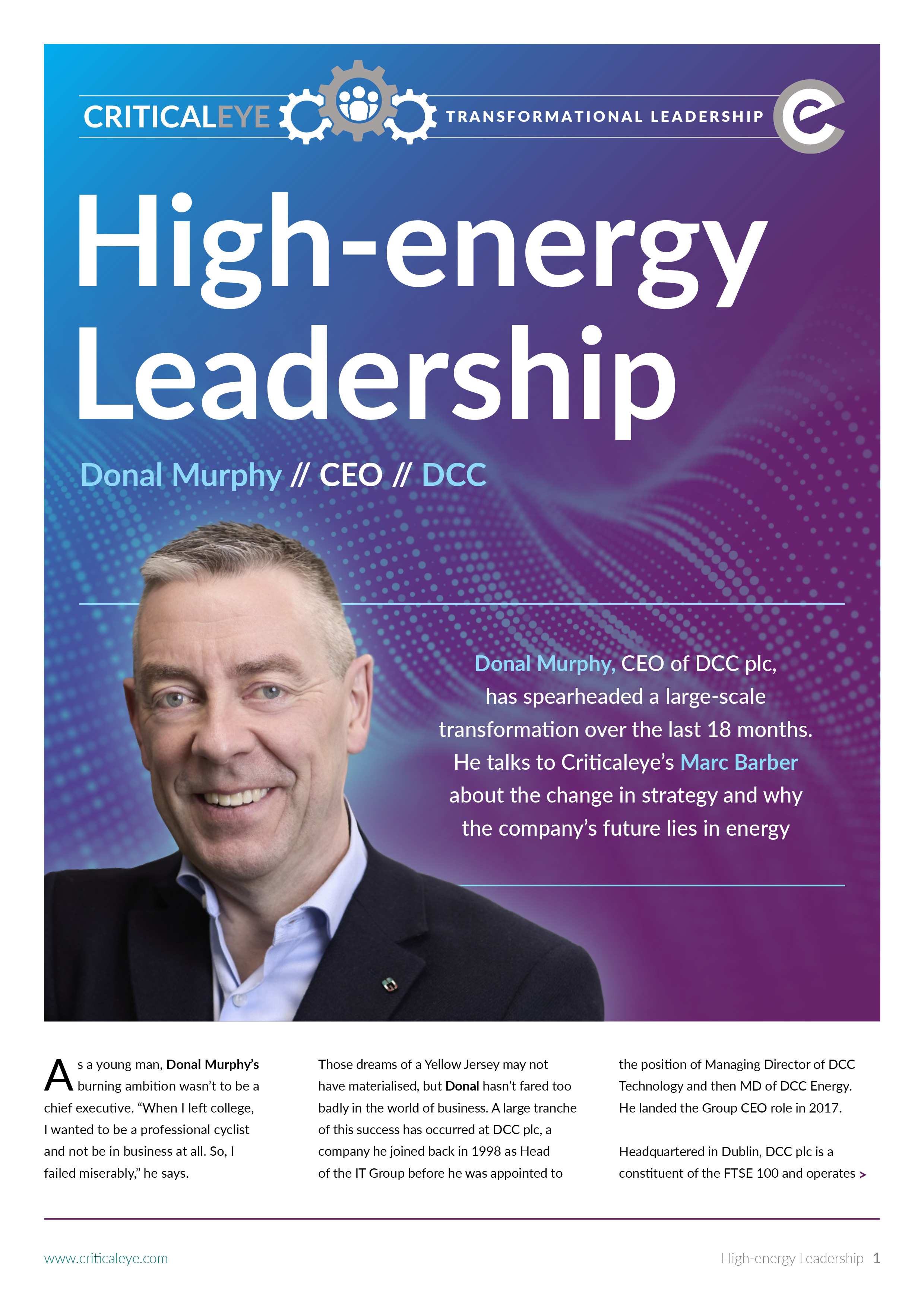
High-energy Leadership

Authored by , Director of Content, Criticaleye
Donal Murphy, CEO of DCC plc, has spearheaded a large-scale transformation over the last 18 months. He talks to Criticaleye’s Marc Barber about the change in strategy and why the company’s future lies in energy.
As a young man,
Donal Murphy’s burning ambition wasn’t to be a chief executive. “When I left college, I wanted to be a professional cyclist and not be in business at all. So, I failed miserably,” he says.
Those dreams of a Yellow Jersey may not have materialised, but Donal hasn’t fared too badly in the world of business. A large tranche of this success has occurred at DCC plc, a company he joined back in 1998 as Head of the IT Group before he was appointed to the position of Managing Director of DCC Technology and then MD of DCC Energy. He landed the Group CEO role in 2017.
Headquartered in Dublin, DCC plc is a constituent of the FTSE 100 and operates in 16 countries, serving over ten million customers. Its revenue for the financial year ending March 2025 was just over £16 billion. The business was founded back in 1976 by Jim Flavin and effectively it was a venture capital vehicle (then called the Development Capital Corporation), which the founder took public in 1994 before finally handing over the CEO reins to Tommy Breen in 2008.
As the business model evolved from its VC / private equity origins into an industrial holdings group, it meant the company, underpinned by a strong appetite for M&A (400 businesses have been bought since its public listing), was diverse in terms of what did across its divisions.
In many ways, it was the classic conglomerate. “Diversity has been very important actually to the success of the Group and its consistency,” explains Donal. “You know, we're 32 years old as a public company and we've grown the profits almost 14 percent a year over that period. So, it’s been very important in terms of the growth in the underlying business and the optionality that it gave us to both deploy capital and scale in different markets.”
However, in more recent times, it became apparent that the value of the Group hasn’t necessarily been reflected in its share price. As a result, the Board has made some hard decisions which culminated in an announcement at the end of 2024 to simplify the overall strategy of the organisation. This entailed divesting its healthcare and technology divisions and focusing primarily on energy products, solutions and services.
It’s a move that makes the business easier to storyboard to core stakeholders and, strategically, it’s a logical step given energy was the largest part of the business—responsible for 70 percent of its profitability. “As we look forward, the opportunities to grow at a consistent rate, both organically and through M&A, are better for us in the energy sector,” Donal remarks.
The decision to divest has led to the sale of DCC Healthcare in September 2025 to the private equity firm, Investindustrial, for a total enterprise value of £1.05 billion and, a couple of months later, the Info Tech business was sold to another private equity outfit, Aurelius, for approximately £100 million. The expectation is that the remainder of DCC Technology will be sold by the end of 2026.
By simplifying the business, it makes the growth strategy much clearer. In essence, DCC plc is now comprised of ‘Mobility’, which is made up of retail service stations it either owns, operates or supplies, as well as fleet services. The remaining 75 percent of the business is comprised of energy ‘Solutions’, which provides products and services to commercial, industrial, agricultural and domestic customers. The stated ambition now is to double the business by 2030.
The divestments and structural changes should create new opportunities for deploying resources and utilising the Group's deep expertise to engage with customers. Donal says: “The core business is transforming. We're moving from being more of a product focused business model, where we were selling liquid gas, liquid fuels or services, to now where we want to be in a country looking at it from a customer perspective and saying, ‘Well, we want to sell a range of multi-energy solutions to those customers.’
“That's very much a business model transformation piece and it goes right down to the skill set of the sales force.”
The de-layering of complexity within the organisation should allow it to move faster. He says: “We fundamentally believe that you need to have agility to stay close to the customer. For instance, we sell liquid gas in bulk tanks and cylinders in lots of different markets, but actually the commercial propositions are very different in most of those markets.
“So, if you try and just have one proposition, you won't be able to meet the needs of a customer in that market. We want to have that flexibility locally, but then we obviously want to get the leverage of being a bigger organisation.”
High Performance
Given that 30 percent of the business has been divested, the leadership structure inevitably needed changing to shape what’s required going forward. Donal says that “for teams nowadays, you need to have such a mix of skill sets because the world of business is moving at a pace”.
Mindset and behaviours are vital too and Donal comments on how the culture of DCC plc has “been germane to our success over the years”. He explains: “A winning culture across the organisation drives an awful lot of the performance. You clearly want people that really understand the business, but you also want them to get up every day and want to make a difference. I think that's the essence of high-performing teams.”
The thinking behind the strategic pivot of the last 18 months makes sense on multiple levels, but that doesn’t mean it’s been straightforward. Donal acknowledges the decisions taken have been the hardest part of his tenure as CEO. After all, it’s meant saying goodbye to people who had been with the business for many years.
There’s no question it’s been a bold call. The transformation at DCC plc feels like a timely case study in a CEO and Board analysing the strategy of a business and taking a long-term view on the future. Donal says: “I think the most important bit of advice for any CEO – and I need to remind myself of this occasionally – is to make time to think, because our most precious resource is our time. Everything else can be leveraged, whereas your time can't be...
“There's so much noise in the world and you only get one shot at it… The other thing I always ask myself – and I genuinely do this every day when I go home – is: ‘Did I add any value today?’ And I think that's a very good litmus test for all of us… ‘Did I make the Group more valuable?... Did I make someone a better person in terms of their own development?’”
Donal goes on to reflect that a CEO needs to also be “given the time to make a difference”. As things stand, the expectation is that DCC plc can double-down on building growth organically and via M&A to continue driving high performance in the energy space.
“You know, we've delivered super results over a very long period and it's not been reflected in the share price and that's a frustration, clearly,” he says. “But the answer to that is the strategic change and that's why we're doing it. Hopefully, it will be reflected in the value of the Group.”
So far, he’s bang on track.

 Displaying 1 to 3 of 151

















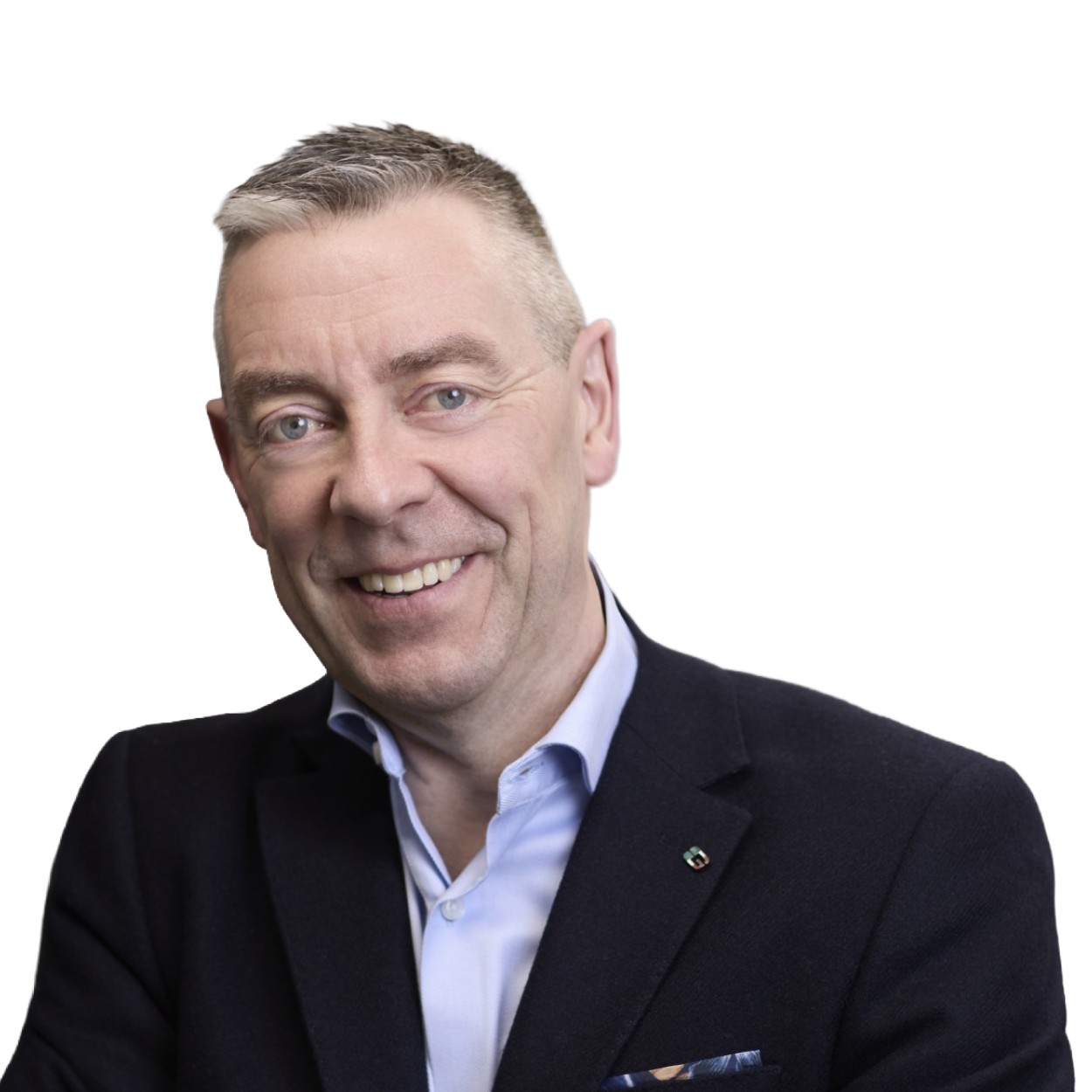 Donal Murphy