The conversation around artificial intelligence in the workplace has reached an inflection point. The question for Chief People Officers (CPOs) is no longer whether to adopt AI, but how to reimagine the fundamental architecture of work from the ground up.
Most organisations begin their AI journey in the familiar territory of process improvement. The initial focus on productivity is understandable and necessary, but it represents only the first chapter of a much larger story. Speaking at Criticaleye’s recent CPO Retreat,
Kat Bernardes, Executive Director, Head of HR Transformation for LACE Partners, commented: "Most start with process: 'How can we embed AI to make our processes more productive?' ... Some look at it in terms of talent and jobs, but where it makes the biggest difference is when we think beyond that into role design of the future across all parts of the organisation.”
This distinction is critical. Process optimisation asks how we can do current work faster. Strategic transformation asks what different work we should be doing altogether.
Mohammed Chaudhri, Chief Economist and Director of Market Intelligence of Experian, commented: "When are we going to look at AI as technology that doesn't just make our workforce quicker at doing what they're doing today? When are we looking at AI to make our workforce do something different, to do the next plan of action that's going to take your business into another market, into another product? We're still early on that journey."
He continued: "The winners and losers, in terms of workforces and skills you're going to need, aren't just about giving people the [tools for] how to use AI and making sure they log in once a day. It's about making sure we change the culture and have that infectious curiosity going forward."
Yet such deep-rooted transformation carries risks that extend beyond implementation challenges. The most thoughtful leaders are grappling with AI's potential impact on human capability itself.
Kat reflected: "What I worry about is it [AI] being a threat to our critical thinking and mental health. There's a risk we'll become less intelligent because we're not challenging ourselves to think."
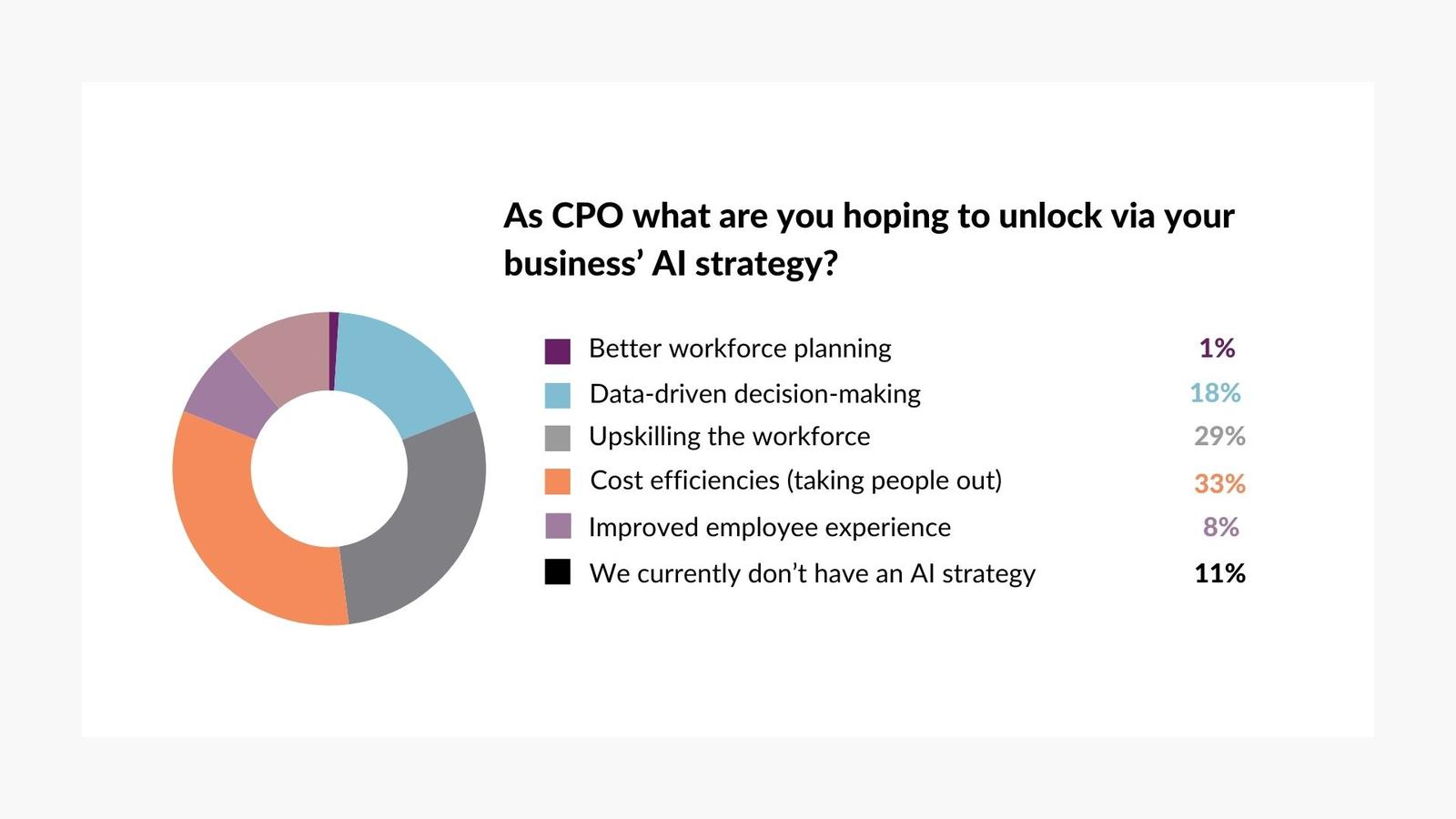
Responses taken at Criticaleye's CPO Retreat, February 2026
The AI Age
During the course of the CPO Retreat, which was held in association with
LACE Partners and
Simplyhealth, it became apparent that many CPOs are in the throes of leading large-scale transformations.
Jamie Wilson, Managing Director, Group Services at Criticaleye, said: “CPOs are at the heart of a multitude of changes currently unfolding in businesses, which feeds into culture, people, productivity and performance.
“There is understandably a lot of discussion about technology and, specifically, the impact of AI, but the longer-term view needs to be on building the right skills, talent and leadership.
"It also reinforces the importance of retaining that curiosity as a leader so you’re gaining external reference points to benchmark your thinking. For me, that’s essential given the pressure to navigate short-term commercial pressures so that you’re seeing the bigger, strategic picture.”
Amanda Cusdin, CPO of Sage Group, commented: “Our strategy is around how we build organisational capability, skills, leadership and culture for an AI age”.
She continued; “The people who will lose their jobs to AI are the people who don't embrace it and use it. We are absolutely convinced that technology will continue to need humans, because humans need to make the decisions that technology can't.”
According to Amanda, the three core cultural pillars of the organisation need to be around a “growth mindset, focus and being bold”. She added: “We can't follow; we can't use our tried and tested playbooks. We're going to have to do things differently."
Perhaps the most important insight for CPOs is about ownership, accountability and embracing innovation. "Get ahead,” she urged the audience. “Don't wait for the Board or the CEO to tell you what they want the people agenda to be. Get ahead and own it.”
The organisations that will thrive in the 'AI age' will be the ones that use it to become something genuinely different. The challenge will be to create organisations where technology and the human factor combine to unlock entirely new possibilities.

.jpg)